Showing posts with label Photography. Show all posts

Tuesday, June 27, 2017

Düsseldorf, Tour De France, Kraftwerk, Air, Friends, Adventure, YES PLEASE!

Dusseldorf
Photo by @puthoor_photo via Flickr
In just a few hours, David and I will be boarding a plane to Frankfurt & then taking the train to Düsseldorf. Our wild Kraftwerk adventure is leading us to their home town to meet Jan Wiefels who wrote about our wedding in the Rheinische Post! He extended a pair of tickets for us to see Kraftwerk & Air & we booked our travel immediately. Who could say no to an opportunity like this (not us!)?!

Thorsten Schaar reached out to David and I, inviting us to take part in an International Press trip of Kraftwerk and the Grand Depárt (the start of the Tour de France). David is writing an article on the event for Electronic Beats magazine and I'll be their photographer for this story. I can't believe our good fortune. It all began with the pictures I took of David being posted to his Flickr photostream & now my own Flickr account was essential in establishing that I can shoot good pictures every now and then!

Friends of ours will be joining us in Düsseldorf (Marshall, Les, Hilde & our very own Scott Stapleton!) Friday, Saturday and Sunday we'll be with the press group. The members of the International press we're traveling with are authors, musicians, magazine founders, literary agents and sports writers. It's sure to be an interesting group of people.

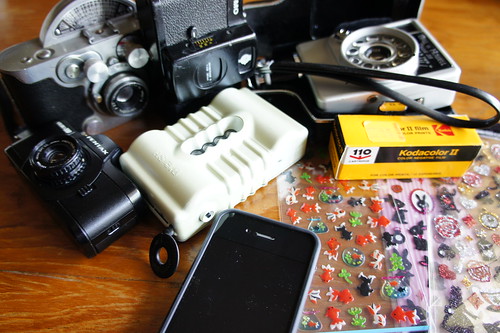
Many, many photos will be taken. I'm bringing my Polaroid Spectra, Sony a6000 & my trusty Pentax 110 (of course!). My purse/camera bag is heavy with lenses, spare batteries, film and my FauxPro.

Gifts were made with my handy dandy new Cricut machine! So many t-shirts!!!


Tuesday, September 22, 2015

Mail Order Film Developing: 110, Minox 8x11 cassettes and more!

I've been solely shooting film for the last few months and the time had come to mail away my 110 cartridges for developing. Several years back I could get 110 film developed at Wal-Mart but that's not possible anymore. C'est la vie, I'm saved from having to step foot in Wal-Mart, there's no down side to that!

I use Blue Moon Camera for my mail order film processing. They're consummate professionals when it comes to their customer service and the quality of their prints.

Much to my surprise when I landed on their site was this advert for the MINOX spy camera film they make!

Shop SPY FILM for MINOX Cameras

Typically I'm not the target audience for advertising, but they got me. Hook, line and sinker. I've seen MINOX cameras for sale on eBay for years and years. I never thought anything of them, since what is the point in buying a camera if you can't get film to put in it?

Well, that's all changed. I'm late to the game on this one, Blue Moon has been an authorized MINOX film manufacturer for a while now. It was news to me.

What did I do? I immediately found a MINOX C with a reasonable Buy-It-Now price on eBay, bought the battery adapter for the MINOX C and two cassettes of film from Blue Moon.


Now I must wait patiently for it all to arrive.

Here are some shots I've taken with the Pentax 110. It's a fantastic little camera and I'm super excited to see how the MINOX shots turn out!


Wednesday, April 3, 2013

Lomography Smartphone Film Scanner [unboxing and first scans]


I was an early backer of the Lomography Smartphone Film Scanner Kickstarter project. The scanner arrived a few weeks ago, but I'd been waiting to open it until the Lomography Scanner app was available via the iPhone app store. Well, the app was finally released yesterday, so today I opened it all up and gave it a whirl.


The film scanner is a little plastic gizmo that has a backlit lightbox at the base of the scanner (two AA batteries not included), several plastic expansion stackers (in order to adjust the closeness/focus of your smartphone camera) and an adjustable holder for your smartphone at the top. It also comes with a little foam shim to keep your phone level against the opening to the lightbox.

Your first choice is to select regular, lomokino or panoramic for your negative type. Then the scanner app gives you several options for the images you're scanning in: NONE, NEG, B&W, SLIDE, XPRO and REDS. It's not entirely clear what the negative settings are for and there isn't any context help built into the first release of the scanner application. I chose B&W for my negatives, but perhaps I should've chosen NEG. It's hard to discern the difference between the two settings.

There aren't any separate controls for white balance or exposure. I was able to adjust the white balance by touching opposite corners of the image before taking the photo, but it was hit or miss at best.

I couldn't find my shoebox of negatives, so I used some black and white negatives from my community college photo class (circa 1992). Making a print of every image I shot wasn't feasible at the time. Firstly due to the cost of the photo paper and secondly, not every image on the roll was good enough to print. Below is a slideshow of a few selected images I scanned in. There's one of Salt 'n' Pepa from the 1992 Inauguration festivities, a couple of self portraits, a sequence taken for a photo class project called "Portrait of Self Without Self", and a few of my first car (a 1964 Plymouth Barracuda).


The scanner device is pretty cool, even if it the smartphone app could use a little help. Now if only I could remember where I stashed that shoebox of negatives...

Thursday, March 8, 2012

The Sony NEX-7 has finally arrived

After months and months of delays due to the horrible flooding in Thailand, Sony has started shipping the NEX-7 orders that were placed through the Sony website. My order arrived via FedEx this morning, a few hours after Stephen Foskett received his NEX-7.

Of course, I haven't read the manual (although I probably should - there are a billion new features I need to learn about) so the first pictures I took were with the stock lens, and everything set to auto, with the exception of the color setting set to Vivid.

I swung by the office to pick up the Cisco 3600 series AP that had been delivered (beta testing new Cisco features), and on the way back I stopped at the 360 boat ramp to take some test photos. It was very overcast, not the best day to be taking photos. Out of all the big differences between the NEX-5 and the NEX-7, I have to say that I love the view finder. The green grass I saw through the viewfinder looked a lot different than the green grass in the final pictures. The grass through the viewfinder was cartoonish electric green, and that's not what was in the photos. I'll have to read up more on what I should expect to see through the digital viewfinder before I use that for composing a shot with ISO/f stops.

The picture files are huge, obviously. They've ranged from 5 - 11Mb per picture, and storing upcoming digital photos is something I'm going to have to start dealing with sooner than I'd imagined.

DSC03921
When I got home, I adjusted the ISO and aperture on the tree in the front yard to see what the image would look like when it was overexposed. The tree images still have a lot of detail (IMO) considering how far I've pushed the exposure with the aperture almost wide open (5.6). Indoors I still had the aperture wide open (4.5) to pick up as much detail as possible from the ambient room light.
DSC03940

Clarity? Well, in the self portrait I took by the 360 bridge, I can tell I have an eyelash in my right eye. Mind you, I couldn't feel it, but the NEX-7 captured it in the photo. The indoor self portrait in the bathroom mirror was less detailed at full resolution, probably because I'd adjusted the exposure a bit by then, and maybe due to the camera trying to focus on the mirror itself, rather than my reflection.

DSC03898


DSC03944


Friday, September 2, 2011

Sony NEX5 Lens Fun

I'd been waiting to see when the Sony NEX macro lens would be available, but I found a modular kit of tubes on eBay & ordered them to see what it was all about. The shipment of macro lens and lens adapter fun arrived yesterday and I put the macro rings and Pentax 110 adapter to the test this afternoon.

The Macro Extension Tube Ring is essentially a series of threaded rings that allow you to increase the distance between your existing NEX mount lenses and the NEX sensor. I've uploaded the sample pictures to Flickr so that you can see the differing focal lengths.

The Pentax 110 Lens to Sony NEX adapter is exactly what it sounds like. I have three different Pentax 110 lenses (18mm, 24mm & 50mm) and it was interesting to combine them with the macro rings to see how close up I could get.


I took two different batches of photos and uploaded them to Flickr. I haven't yet picked a favorite Macro ring & lens yet, but there are a bazillion possible combinations.

Saturday, April 2, 2011

The Impossible Project -new- PX 680 Film


The Impossible Project just celebrated their first year in business, and with that - a recent beta testing is under way of their new PX 680 color film. This color film is rated ASA 600 for all the 600 series Polaroid cameras languishing in closets all across the globe. 


I've had a Polaroid One Step Flash since the early '90s and I've been eagerly anticipating a replacement to the Polaroid 600 film.  Old stock of Polaroid 600 film can still be found on eBay, but I've been buying old stock Softtone Spectra film from The Impossible Project to help fund their quest to reverse engineer all types of Polaroid film.


I purchased a couple of packs of the PX 70 Color Shade First Flush film and got shooting with my trusty 600 camera.  I have to be honest, I was disappointed in the results.  I was hoping for the same rich colors I'd gotten with old Polaroid film, and the film from TIP wasn't quite there yet. The colors were washed out, and regardless of which camera I used (SX-70 or the 600 camera) I just didn't see the saturation of color I remembered.


The old stock Polaroid film was very contrasty and the colors were very rich and vivid. Of course when the film was freely available on store shelves, it was usually out of my price range.  I only have a few shots from all the years it was being made - I couldn't afford to buy it nearly as often as I'd like. The best series of pictures came from a trip to Mardi Gras back in 1992.


Well, all that changed today.  My shipment of the PX 680 film arrived on March 31st, but I waited to crack it open until today.  I took my 600 camera to the local Central Market grocery store. They have a great produce section full of all kinds of vibrant colors just waiting to be used for test shots.


Perhaps Saturday wasn't the best idea for this, but in any case I was able to use up the whole pack of film. I will say that the pictures develop very slowly. I'd guess that they take at least 2 minutes to completely develop. I used the 600 camera on the middle exposure setting, and all these pictures were taken indoors under grocery store lighting with the camera's flash. I shielded them from the store lighting after shooting the picture, then put them in my purse to develop while I moved on to the next subject.


The PX 680 film worked well for saturated oranges and reds. The yellows were a bit washed out, and the dark purples of the potatoes turned out a lot darker than they actually were.


The carrots looked great all lined up and tightly bound in purple rubber bands. The picture turned out a bit dark. For the next pack of film I shoot indoors, I might try moving the exposure bar over to the "light" setting so the pictures come out a bit brighter.


Overall, I think my favorite picture is of the rhubarb and radishes. The difference in the reds and purples in the bunch of radishes is noticeable, and the rhubarb is a bit out of focus. I like it.


I wanted to take a picture of the roses in the the floral section, but the lady working there told me that Central Market doesn't allow photography in the floral section, or any other section of the store for that matter. I can't imagine why. What do they care if someone snaps a picture of their plums? So as I was leaving the store I used my last shot in the garden section. Pink flowers.


I'm looking forward to the next release of PX 680 film - it is much, much closer to the Polaroid 600 film I remember. This is a remarkable accomplishment from the crew at The Impossible Project. In only a year they've been able to reverse engineer color instant film for one of the most common instant cameras ever made.

Friday, September 24, 2010

The Impossible Project

The Impossible Project is a group of people dedicated to creating a new instant analog film product designed to be used in Polaroid cameras.  The first type of film they created is a black & white/sepia tone film called Silver Shade.  Just recently they've launched the first new color film for Polaroid cameras called Color Shade.


When I found out that The Impossible Project finally had film available for purchase I quickly placed an order.  At the time the only Polaroid camera I had was the 600 model, so I began an eBay quest to find cameras to fit the film I'd bought.


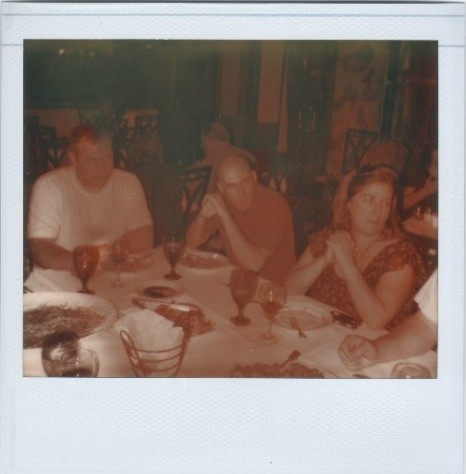
So, now with a few more cameras in my arsenal, I could pick & choose which one I was going to take to Tech Field Day.  I opted for the Spectra (on the right) because it is the widest film format Polaroid made, it is auto focus (sonar!), has a flash and is compact for traveling.


During the three days I was in San Jose for Tech Field Day, I was excited to be able to introduce The Impossible Project film for Polaroid cameras to a large group of people.  I imagined that a lot of people weren't aware you could buy film for Polaroids anymore - and I was right.


 Tech Field Day gave me an opportunity to gain access to cutting-edge data centers and networking hardware.  I thought it was wonderfully fitting to contrast the high tech with the analogue lo-tech Polaroid camera.  I brought along some deadstock Polaroid film, and a pack of the PZ 600 Silver Shade film by TIP.


The first cutting-edge gear/analogue picture was of the new HP A12500 Data Center switch.  This bad boy is nicknamed "The Widowmaker" cause it took 6 men to lift it into the data center rack.  This bad boy can have up to 512 10G ports or 864Gt ports - moving 6.6 Terabytes of data PER SECOND.


I took a Polaroid of it & tweeted it before it was done developing.  Sure enough, someone thought it was an old picture!


The visit to the Juniper data center was equally exiting - the room was filled with the din of cooling fans. There's just something about a room crammed to the rafters with white noise and blinking machinery. A certain je ne se quoi if you will.

The second picture I took was of the Juniper T1600.  It supports 160 10G ports, 16 40G ports or 8 100G ports. Capable of moving 1.6 Terabytes per second..

Now granted, the picture on the left doesn't match up with the switch in the rack, but they're both T1600s.


The real photographic joy of Tech Field Day was the trip to the Computer History Museum.  How cool is it to take Polaroids of the first mouse, the Cray-1, the Babbage Difference Engine and the first hard drive?!
I was giddy I tell you. 


The full set of museum Polaroids is on my Polanoid.net page. http://bit.ly/CHMPolaroids
The main link to my Polanoid.net page is http://bit.ly/MyPolaroids

At the final Tech Field Day dinner I cracked open the PZ 600 Silver Shade film.  I hadn't used any of the Silver Shade film by The Impossible Project yet, but I'd read that the film exposure was temperature sensitive.  The sweet spot for proper exposure is around 72° F and I figured that most of San Jose inside and out is about that temperature in mid-September.


All of the dinner pictures turned out great, especially considering that I was using a flash indoors.  I covered one shot with my hands while it was developing to test the warm temperature overexposures I'd read about - it's true.  The warmer the picture when it is developing the more overexposed it will turn out.


I am very pleased with the quality of the Silver Shade film by The Impossible Project - I've already lined up my next film purchase.  I hope I was able to spark the curiosity of a few people to try film from The Impossible Project.  I think what they're doing is pretty amazing.  They bought the last Polaroid factory in the Netherlands, and they've had to reverse engineer Polaroid film and use less chemicals and materials in the process.

Before you even ask - no, I'm not a paid sponsor or anything like that.  I like taking pictures, and I'm glad that I'm still able to get film for my Polaroid cameras.  There's nothing quite like a Polaroid.

Polaroids make people smile.