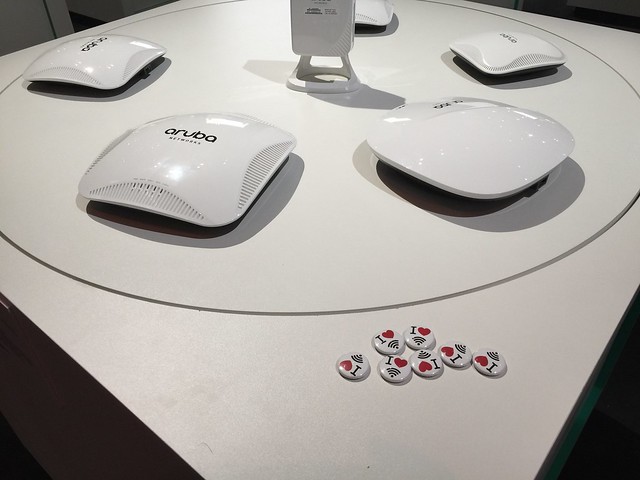
I was invited to take part in the Hewlett Packard Enterprise (HPE) Discover event in London recently. This event was the first expo since HP acquired Aruba. The event was much larger than I'd anticipated - there were at least 16,000 people in attendance. Dozens of demonstration zones were sprinkled throughout the show floor.
The demonstration of MU-MIMO was well done through an animated video equating spatial streams and airtime fairness with fast, small and big cars traveling down the highway. The video was well done and would be useful for non-English speaking attendees of the event.
The show floor had stacks of networking hardware on display (in areas where there was no accompanying demonstration space) which I suspect would fall a little flat for the attendees who were not familiar with the newly aquired line of Aruba access points and wireless controllers. The diplay stack should have had signage to lead the attendee to where they can view this hardware in action or have an HP/Aruba TME explain the intracacies of the hardware.
I used the HPE Discover 2015 Tours application which was created for this event (for iOS and Android). The show floor had HPE(Aruba) bluetooth low energy (BLE) beacons distributed at the thirty-eight (38) strategic locations where the self guided tour could be utilized. At first launching the app crashed when I selected Demo 1212 "Securely integrate IoT deployments". When I relaunched the app, it worked and I was able to listen to the recorded narrator or read the transcript to get more information on the demonstration spot. Out of curiosity I searched the application for the four digit number on a nearby demonstration screen to see if that demo was also part of the app. My search results were blank, so I could only assume that it was not included. I think that the app should have been programmed to indicate that my selection was invalid or that the search query was not part of the app demo program.
The Collaboration demonstration of the interactive conference room was quite compelling. The demo tablets provided to the people taking place in the demonstration allowed their pseudonyms to be welcomed aloud by Cortana which was also launching the video meeting once all of the attendees were in the room. Once the conference started, lights on the outside of the conference room turned red to indicate the room was in use. When the conference ended, all meeting notes or chat session transcripts were automatically emailed to the attendees. The combination of the Aruba BLE beacon in the conference room with the Microsoft/Cortana enablement made a compelling story for automating conference call greetings as well as distributing the meeting notes automatically post onference call.
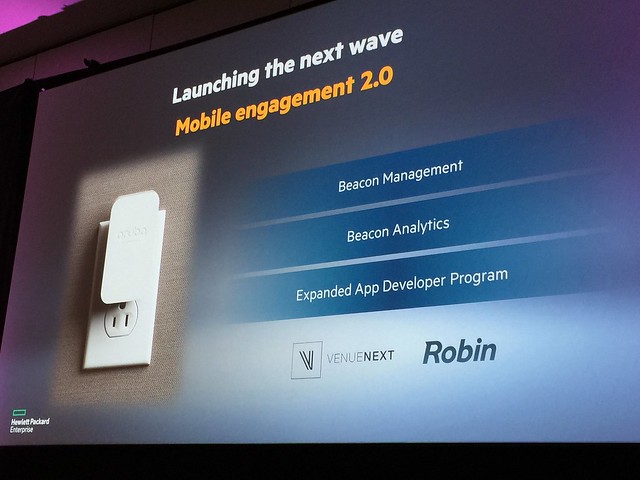 The big announcment from HPE Discover was the Aruba BLE Sensor (in my opinion). The Aruba Sensor is a device which plugs into any electrical outlet (the plug connector types are modular and are available for any plug type). It has a BLE beacon in it as well as a wireless capabilites which allow the sensor to manage up to 10 BLE beacons. This means that if a BLE beacon requires reprogramming, physical proximity is no longer required. The Sensors are managed through a web UI and changes to nearby Aruba BLE beacons can be done over the air. It is also possible to monitor the Aruba BLE beacon status from the same web UI as well as setup notifications/alerts when BLE beacons are no longer detected or if the BLE beacon battery status changes.
It is in the roadmap to bring this Aruba Sensor application into AirWave and use the mapping/location placment of the BLE beacons from the application into the single pane of glass management GUI which is AirWave. What is interesting is that the Aruba Sensors do not require an Aruba wireless infrastructure. Since the application which allows the remote managment of the Sensors and BLE beacons is standalone, it can be used in any wireless deployment situation.
The Aruba Sensor has a small form factor with a micro USB slot as well as an on/off power button (for regulatory compliance) as well as a four pin serial port interface. The serial port is to support legacy connections as well as debugging of the sensor. The BLE beacons that the sensor can manage are either small, standalone beacons which are battery powered, or USB beacons which are supported by recent models of Aruba access points.
I sat in on the session "How tomorrow moves: Mobile-first, cloud-first networking, transforming the digital workplace" led by Dominic Wilde VP of Product Line Management for HP/Aruba and he had a guest speaker (Doug Crawford VP of Global Network Services for WB/TimeWarner) who exolled the virtues of an all wireless office and how deploying a pervasive, location aware wireless infrastructure had enabled the WB to speed the turnaround time for wardrobe requests as well as catering deliveries. These two examples alone is saving WB thousands of dollars that would've been lost due to the length of turnaround time for these tasks previously. The are working to make the WB studio even more interactive through the use of BLE beacons at the major soundstages to bring video clips and interviews of who has used which soundstages and for which films or movies to the guests who are taking a backstage studio tour of the property. I think Mr. Crawford's presentation would have been more captivating and personal than the scenarios presented during the keynote.
My key takeaway was that the wireless capabilities that Aruba offers post acquision should have been highlighted more prominently at HPE Discover. I say this due to the large number of people who stood up and left during the Day One keynote when the topic of a mobile workforce became the topic of discussion. Many people seemed to miss the importance of the joint forces of Aruba and HP because they literally got up and walked out. It could be that all wireless offices haven't caught on yet in Europe (which I find hard to believe) or that the business use cases used during the keynote did not come across as compelling.
Full disclosure: HP/Aruba invited me to attend HPE Discover and paid for my airfare and hotel during my time in London for the HPE Discover event. I received gifts including an umbrella and jacket. The sponsorship of my travel or the gifts I received in no way influenced my opinion of the HPE Discover event.